
Morning summary
- Pending dispatch 4
- Cash due ₹12,40,000
- Rejections yesterday 2
Open the dispatch list
SAMaGRA ERP by ERiKA SOFTWARES
Bill of materials, routes, material planning, costing and the floor, built for manufacturers and nothing else. Switch off what you do not use, skip the steps you do not take, and decide who approves what. It sits beside Tally.
Made in India. Built in Pune by the developer you talk to. Running on the floor at RRA Industries, Pune.
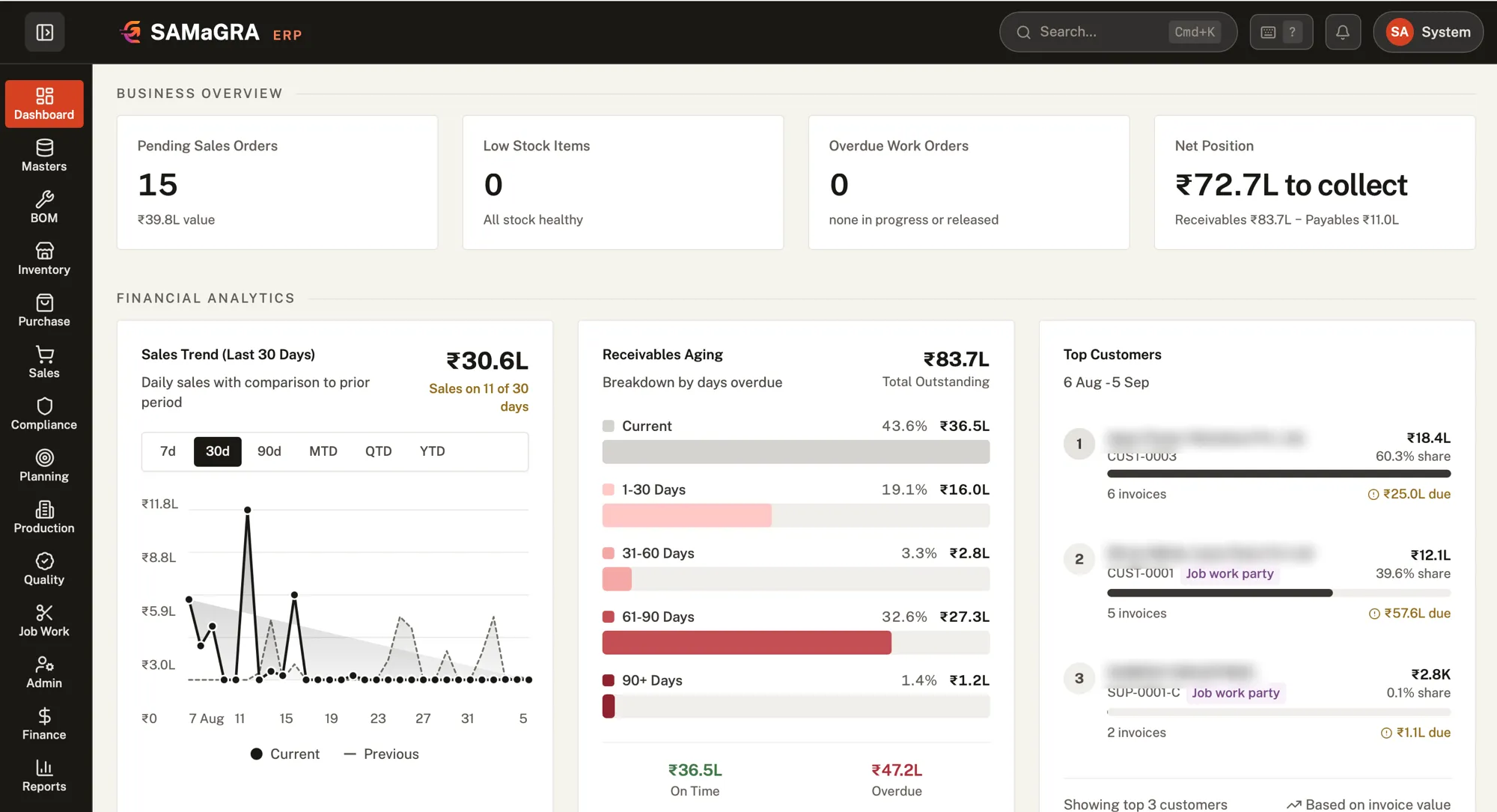
The owner’s dashboard
Pending orders, stock, overdue work orders and cash position in four numbers. The screen the morning message opens.
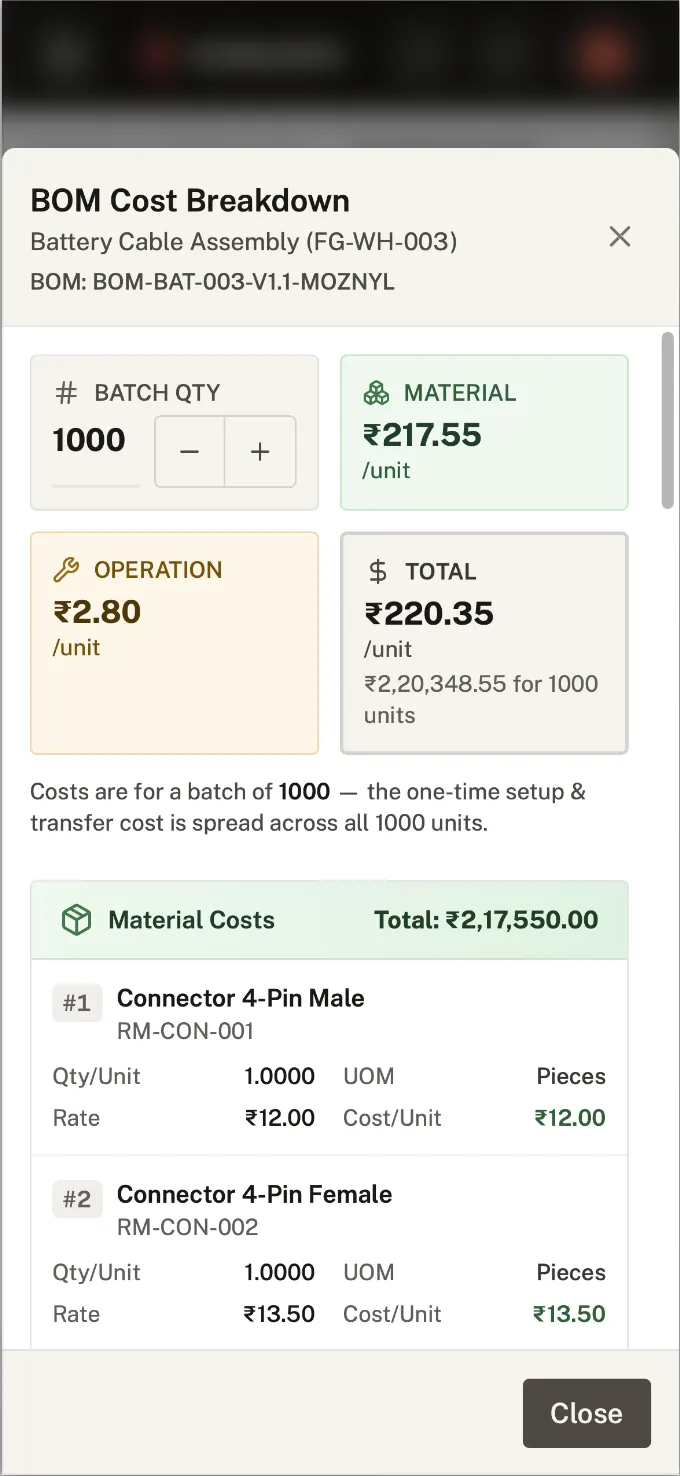
1 · Cost from the BOM
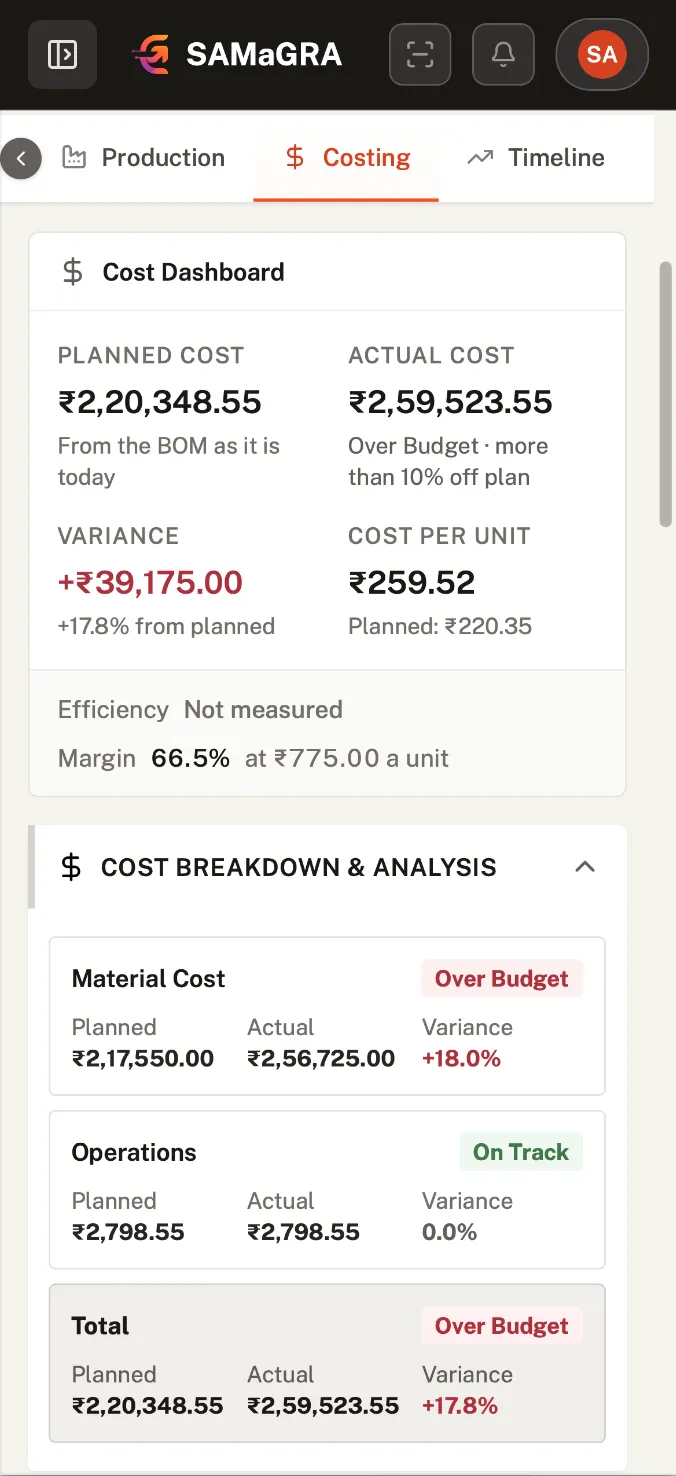
3 · Cost after it ran
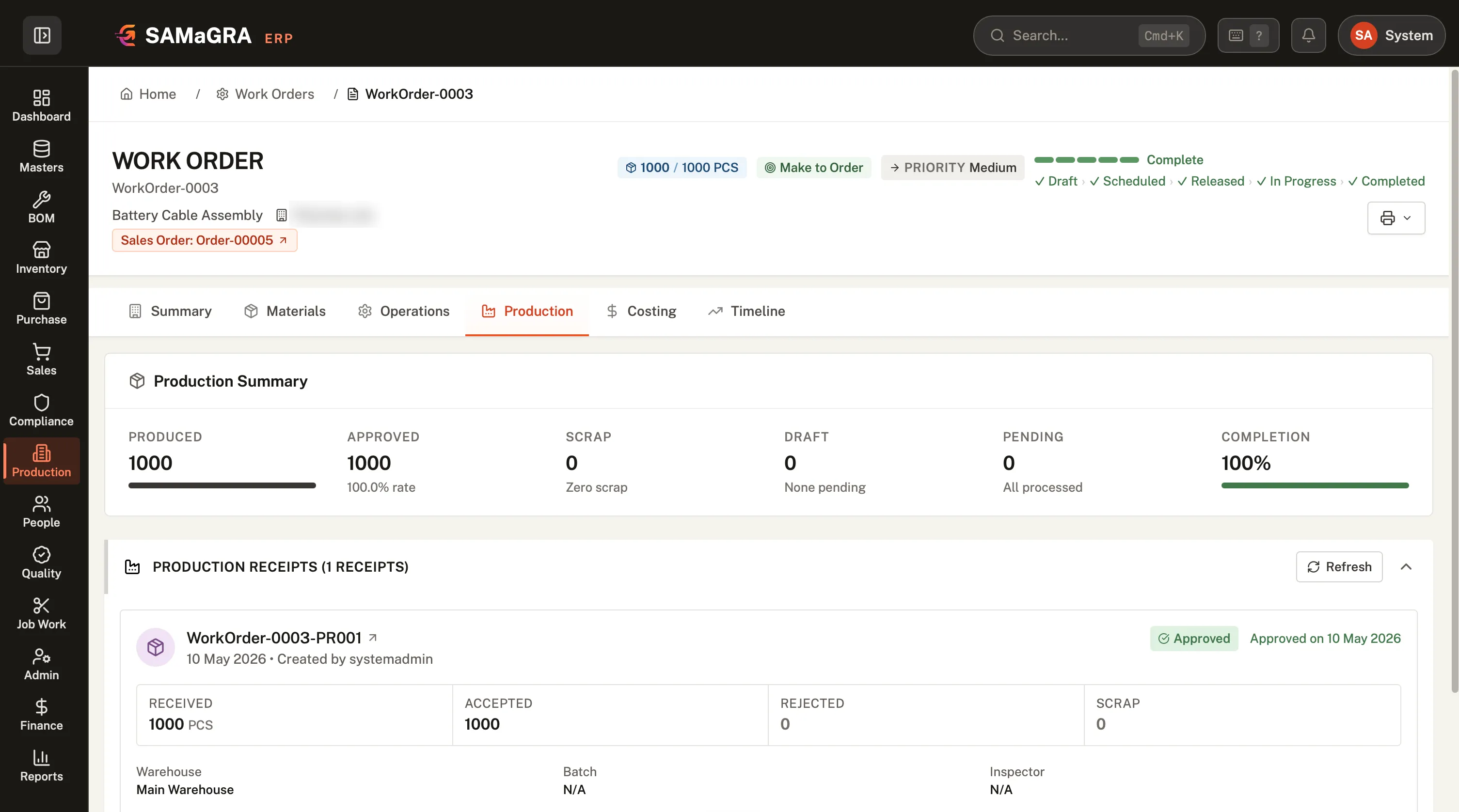
2 · The work order
What it should cost, what was made, what it did cost
Before the quote, the part’s cost from its bill of materials. On the floor, the work order: pieces made, approved and scrapped. After it runs, material and operations, planned against actual, line by line.
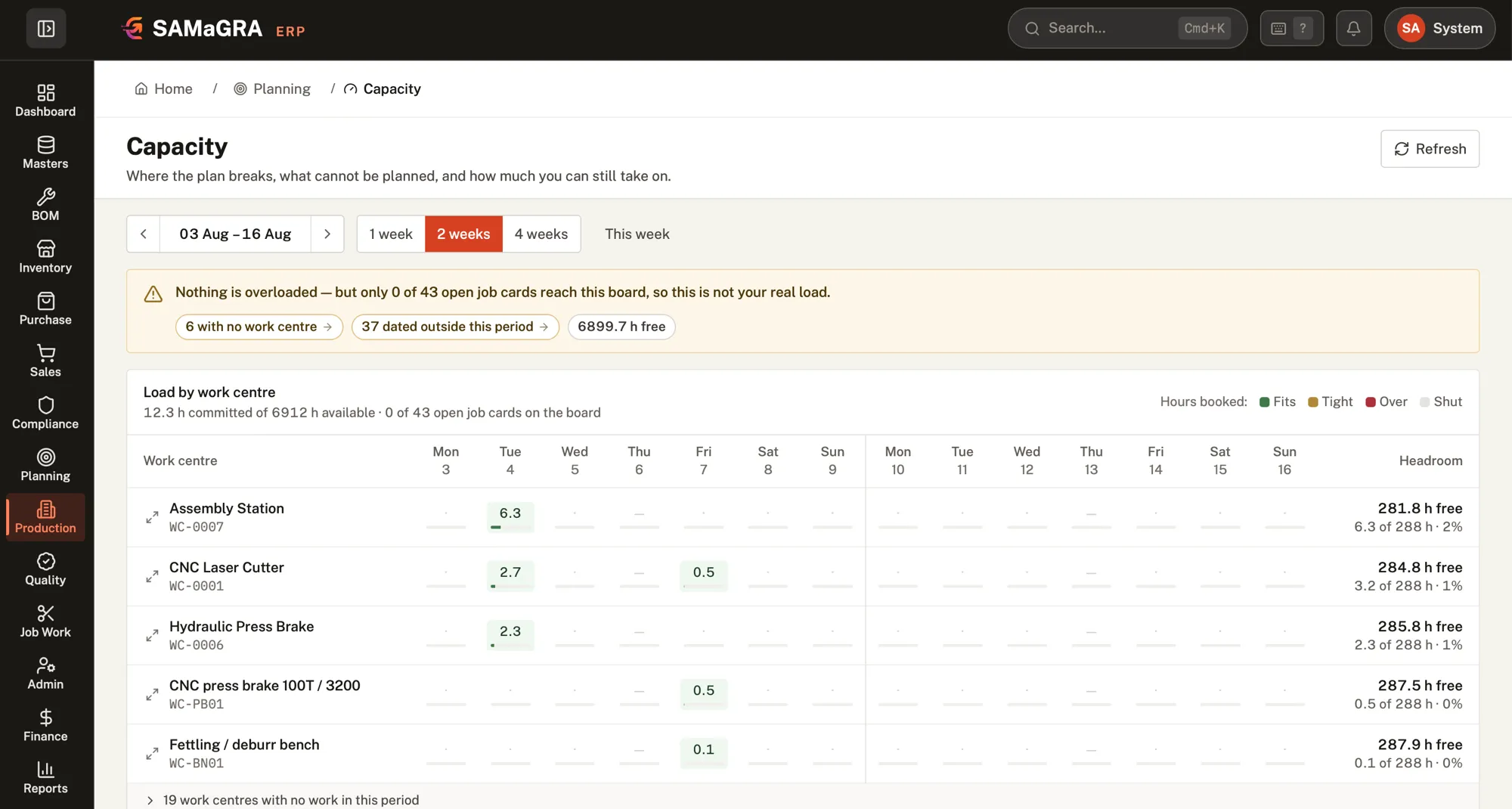
Capacity by work centre
Two weeks of hours booked against hours available, headroom per machine, and the job cards that cannot be planned yet, called out instead of hidden.
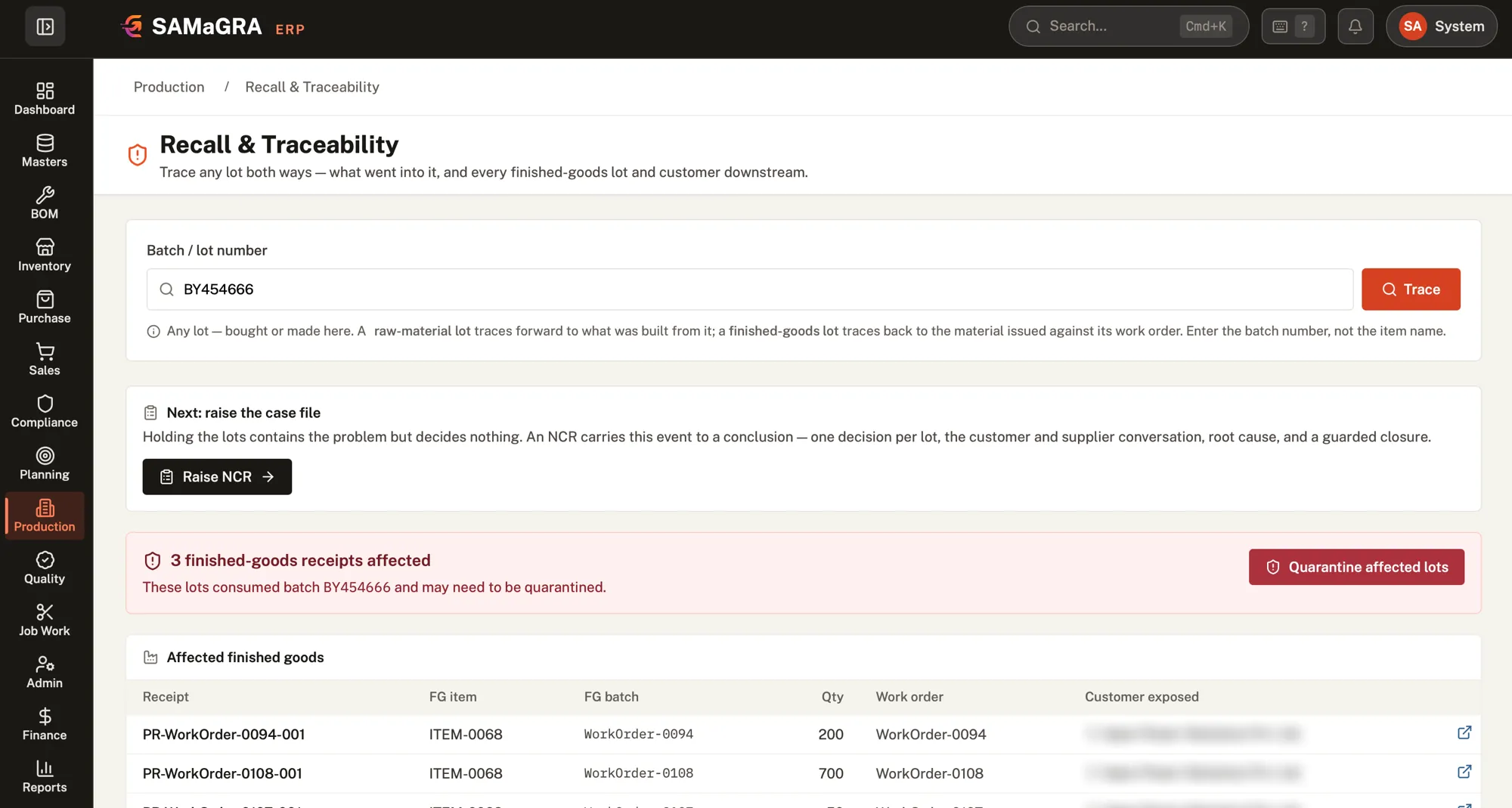
Recall and traceability
One batch number, every finished-goods receipt and customer it reached, and quarantine one tap away.
Set to your shop
Every module is built for manufacturing. Inside each one, your shop decides what it sees, what it skips and what it locks. Shivaji sets it with you when you start, and changes it when the shop changes.
Only the registers, columns and buttons your people use.
Switch off a whole module you do not need, or one register inside it: quotations, routings, delivery notes.
Hide the columns and buttons a list does not need, so the store clerk is not reading the accountant’s screen.
E-invoicing switches on when your turnover crosses the government’s limit, not before.
The steps your shop does not take.
A step your shop never takes is switched off on that document, so nobody waits on it.
No approval on the documents nobody in your shop signs.
When the person who made a document may approve it anyway, it goes through without asking twice.
Who may do what, and above which amount.
Approval only above an amount you set. Below it, the order goes straight through.
Only the roles you name may approve. Any one of them is enough.
Each step on a document can need its own permission, so the person who makes an order is not the one who confirms it.
These are settings, not code written for you alone. So every improvement to SAMaGRA reaches your shop too.
The account of your parts
What it will cost before you quote it, in material, machine time, labour and scrap.
Material from the part’s bill of materials, line by line, with its scrap allowance, at the rate saved on it, on your purchase list or in your stock. It says which rate it used.
Machine time and labour from the route, at each work centre’s rate: setup, running and overhead.
The margin against the PO rate, on the quotation or the order, before you confirm it. A loss is called a loss.
When the customer sends the steel, it counts at zero, and their material is kept to the kilo in its own account.
What the floor actually used against what the bill of materials said, and who made what, on which shift.
Raw material issued to each work order, against what the bill of materials said it would take.
Pieces good, rejected and scrapped, per operator, per shift, entered from the floor.
Every job card at its operation and machine. The supervisor gets a push at each milestone, and when rejections cross the limit.
Hours booked against hours free, per machine, for the next two weeks.
It sits beside Tally and never touches your books. Go home at six and know the factory is fine.
Tally stays
Your accountant keeps Tally. SAMaGRA produces every voucher from the documents you already made and exports them correct to the rupee. Nothing is typed twice.
Paper and permanence
The screen is for you. The invoice, challan, e-way bill and job card are for everyone else, and they read as a serious firm’s register: numbering that never breaks, the right tax lines, your seal, printed the same on any phone or PC.
They come from the same record as the costing and the material account, so an audit is a print and not a week. And the record behind the paper stays yours.
What it covers
How a day runs
The owner is on a noisy shop floor, not at a desk. So SAMaGRA pushes what matters to WhatsApp and stays quiet the rest of the time: three to five messages a day, each one opening the exact screen.
Pending dispatch, cash due and yesterday’s rejections, in one message. If those three are fine, the factory is fine.
Morning summary
Open the dispatch list
The customer’s PO becomes a sales order with its delivery date. You see it; nobody types it twice.
New purchase order
Open the order
Photograph the supplier’s bill. Sārathī, the AI assistant inside SAMaGRA, reads the lines into a draft purchase invoice. You check it and save.
A job card passes a milestone and the supervisor gets a push. Pieces made and pieces rejected are recorded per worker, per shift.
Job card milestone
Open the job card
Delivery challan and e-way bill print together, and the customer’s purchase contact has both on WhatsApp before the truck reaches the gate.
Dispatched
Open the challan
Nothing buzzed that did not need you. Not stock entries, not logins, not drafts. Four messages today, not forty.
What was dispatched, what was collected, and what is first tomorrow.
Evening summary
Mondays add the overdue receivables list, and GST filing dates arrive before they are due. The supervisor has a separate, noisier profile: a push when production is rejected.
Built in Pune
I spent more than a decade building software for large companies — travel technology, then medical devices. What kept pulling at me was what I saw whenever I looked closely at a factory: stock, invoices and compliance sitting in systems that never spoke to each other. SAMaGRA is built with owners in Bhosari, Pimpri-Chinchwad, Chakan and Ranjangaon, and the person who writes the code is the person you message.
Shivaji Kokate, founder
Read the storyA customer, in his words
“GST filing that used to eat four or five hours of collecting and sequencing invoices is now a single download. My CA just verifies and uploads in two minutes. E-way bills are sorted, I finally know my real margins, and I can check any stock in seconds.”
Pricing
Billed yearly, plus GST. The price is printed, the first five shops keep it for life, and you see your own data before you pay.
A manufacturing ERP built in Pune for owner-run factories that buy their own material and sell finished parts: sheet metal, pressings, machined and fabricated assemblies. It knows what a part is made of and how it is made, through its bill of materials and route, so it can say what the part will cost before you quote, plan the material, and follow the floor shift by shift. It is set to the way your shop works, prints the challan, invoice, e-way bill and job card from one record, and sits beside Tally.
Yes, without custom code. Modules and the registers inside them switch on or off; lists show only the columns and buttons your people use; steps your shop does not take are switched off on that document; and approval can be limited to amounts above a figure you set and to the roles you name. Shivaji sets it with you when you start. Because it is settings and not code written for one shop, every improvement reaches you too. For anything the settings cannot do, you talk to the developer directly, with no ticket queue in between.
Yes. On the quotation or the order, the cost comes from the part’s recipe and route: each material with its scrap allowance, at the rate saved on the recipe, on your purchase list or in your stock, and each operation at the work centre’s rate for setup, running and overhead. The customer’s own material counts at zero. The margin against the PO rate shows before you confirm, and a loss is called a loss.
The challan, invoice, e-way bill and job card for any order, printed from the same record. A batch number traced forward to every part and customer it reached, or back to the material issued. The instrument register with each calibration certificate and its due date, and the inspection and rejection records behind the lot. Every register exports to Excel.
Yes. It is designed for a shop the owner runs personally, from a phone on the floor, and it grows with you. Starter is ₹2,400 a month, billed yearly, with no limit on users, and you move up only when the shop asks for more.
No. Your accountant keeps Tally. SAMaGRA runs the factory and exports every sales, purchase, receipt and payment voucher to Tally, correct to the rupee. Nothing is typed twice and nothing is ripped out.
Yes. The tax on every document comes from the calculation engine, never from a typed rate. E-invoice IRN and QR are on the invoice, and the e-way bill goes out with the challan.
Yes. For each customer, item by item: received, used, made, sent back and with you. The columns add up to the closing figure, so their stores can check it against what they hold. It also tells you how many more parts the material in your building will make and which item runs out first. Job-work challans in and out reconcile for the ITC-04 return.
Two to six weeks for a shop with items, recipes and routes to load, depending on your data and how much you want changed. The first pilot, a five-person fabrication unit, was raising challans and invoices from phones on day three.
Yes. Sārathī, the assistant inside SAMaGRA, reads a photographed bill, a PDF or an Excel sheet into draft entries, understands plain-language questions in the search bar, and takes voice input. A person approves before anything is written, and every step is audited.
Yes. It is designed and built in Pune by ERiKA SOFTWARES, and your data stays on servers in Mumbai. Support is in Marathi, Hindi and English.
The one your supervisor still uses in month six. Judge any ERP, including this one, on three things: does it run from a phone on the floor, does the Tally export match to the rupee, and does the person who built it answer when you call. SAMaGRA is built to pass all three; a free trial with your own data is how you check.
Yes, with your real data and no contract. Message us on WhatsApp to set it up.
Five minutes on WhatsApp starts it. Shivaji replies himself, in Marathi, Hindi or English.