
Module · Production and job work
The shop floor, written down as it happens.
Parts have a BOM and a route. Orders become work orders, work orders become job cards per operation, and each shift records pieces made and pieces rejected.
What it produces
- Bill of materials
- Per part, with versions. Routing lives in its own table, never mixed into the BOM.
- Routing
- Operations from a reusable library, on named work centres. Time is entered as hours, minutes and seconds.
- Work order and job card
- A work order per finished part; a job card per operation, with the milestone pushed to the supervisor.
- Production entry
- Pieces good, pieces rejected, per worker, per shift. Rejections over threshold buzz the phone.
- Job-work challans
- Outward DC to the job worker, inward DC when it returns. The rejected quantity travels on the inward line, so ITC-04 reconciles.
What is different about it
Material planning from real stock
MRP reads the BOM, the open orders and the stock ledger, and tells you what to buy and when.
One work centre, two ledgers
The work centre in the route is the same work centre that daily expenses post to, so what an hour on a machine costs can be compared with what the route assumed.
Subcontracting without a spreadsheet
What is out with each job worker, for how long, and what came back rejected, all from the challans.
Also built in
- Work-centre master
- Operation library
- BOM versions with a default
- Scrap and rework with reasons
- Job-work quotations and rates
- Production receipts into stock
- Material variance report
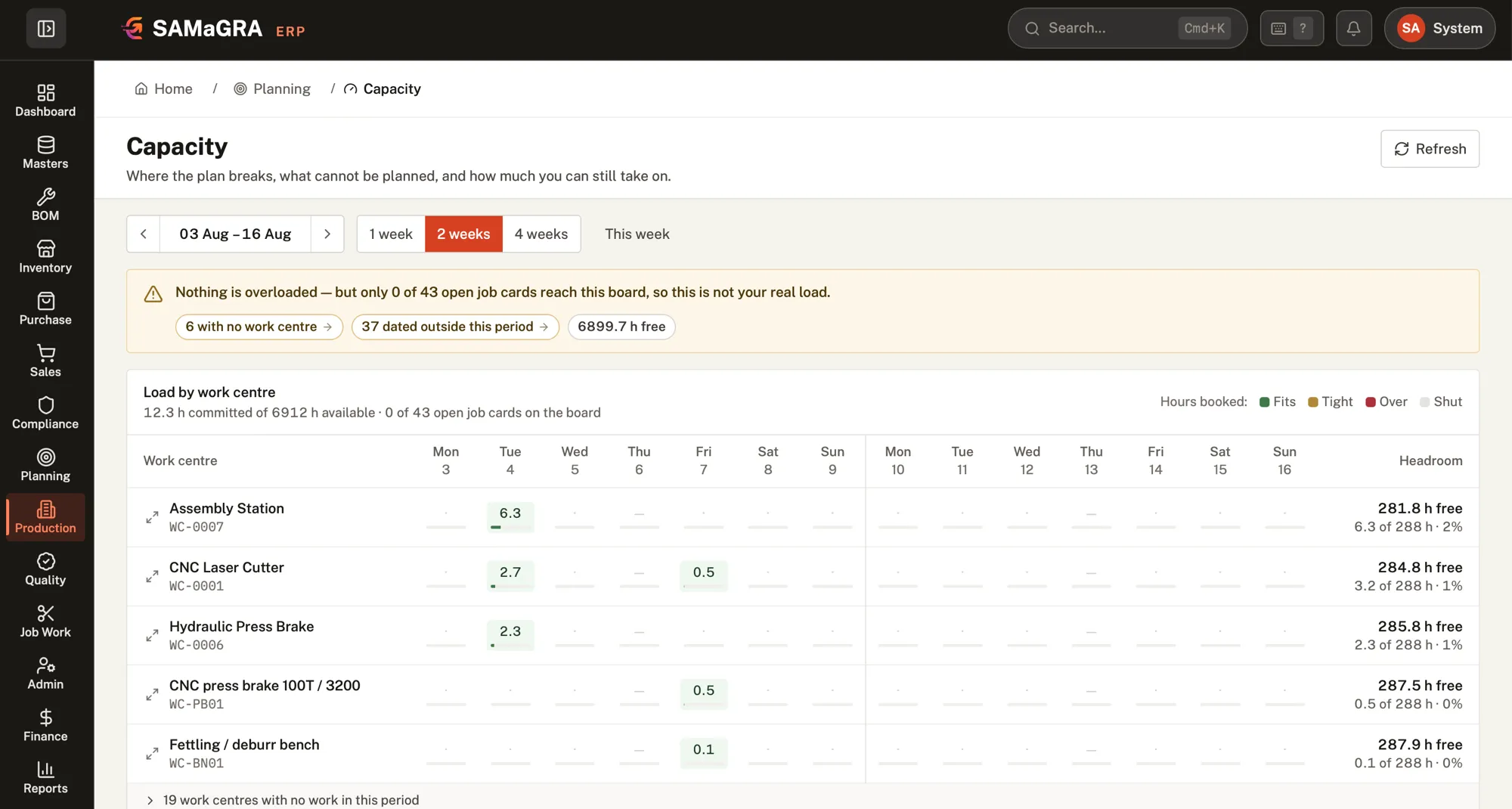
- Capacity board by work centre
Five minutes on WhatsApp is worth more than a forty-page RFP.
Message us. Shivaji replies himself, in Marathi, Hindi or English.